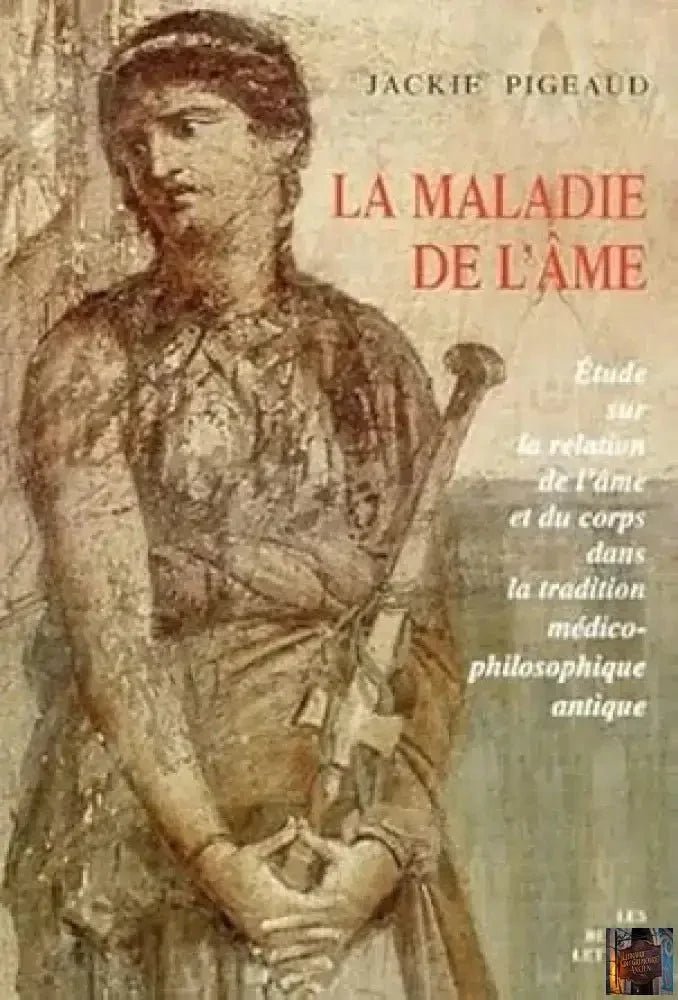
Sickness of the Soul. A Study on the Relationship Between the Soul and the Body in Ancient Medico-Philosophical Tradition
Sickness of the Soul. A Study on the Relationship Between the Soul and the Body in Ancient Medico-Philosophical Tradition
Couldn't load pickup availability
The illness of the soul… the beautiful Platonic expression remains ever-relevant. Not only does it tend to reappear from era to era, but it seems particularly fond of our own.
Whether this illness refers to a vague sadness, a taedium vitae, or, more seriously, depression, it simultaneously involves both moral and physical suffering. The soul and the body are divided but reunite in pain, so much so that "the illness of the soul comes from the fact that we have a body."
From this paradoxical observation, Jackie Pigeaud derives a history, that of the triumph of dualism, of the burden of the soul and the body constrained to be separated and yet together in perpetuity. This history originates in the Greek world, and more precisely in its philosophy. The division between illnesses of the soul and other illnesses, that is to say, illnesses of the body, belongs to philosophy.
Medicine would have been greatly relieved by this partition. Does this mean it did not intend to be philosophical? Undoubtedly: Hippocrates offers a good example. The tacit agreement is as follows: the soul belongs to the philosopher and the body to the doctor. Cicero deals with passions, and Galen suspends his judgment as soon as he approaches the psyche.
Everyone benefits from this, but the consequences are significant: the partition of the field of diseases, the place of the "patient" in society, and the treatments to be provided, particularly for madness, depend on this initial dualism. If the legacy of Greco-Roman medicine is rich, it is also very heavy and has seen developments throughout the history of medicine, up to the constitution of psychiatry in the 18th century. Written with personal and profound style and thought, this book is an essay on the history of medical thought, from Antiquity to the present day.
“La Maladie de l’âme” was a success upon its publication, and this success has not waned since. Unfortunately, the work was no longer available: "books have their destiny," the author commented. With this revised and augmented edition, accompanied by a new preface, the book finally receives the fate it deserves.
Jackie Pigeaud (born 1937) is professor emeritus of Latin literature at the University of Nantes and a member of the Institut universitaire de France.
He is also the author of “Folie et cures de la folie chez les médecins de l'Antiquité gréco-romaine. La manie” (Madness and Cures for Madness among Physicians of Greco-Roman Antiquity: Mania), published by Les Belles Lettres.
Sous réserve de disponibilité chez l'éditeur.
View full details