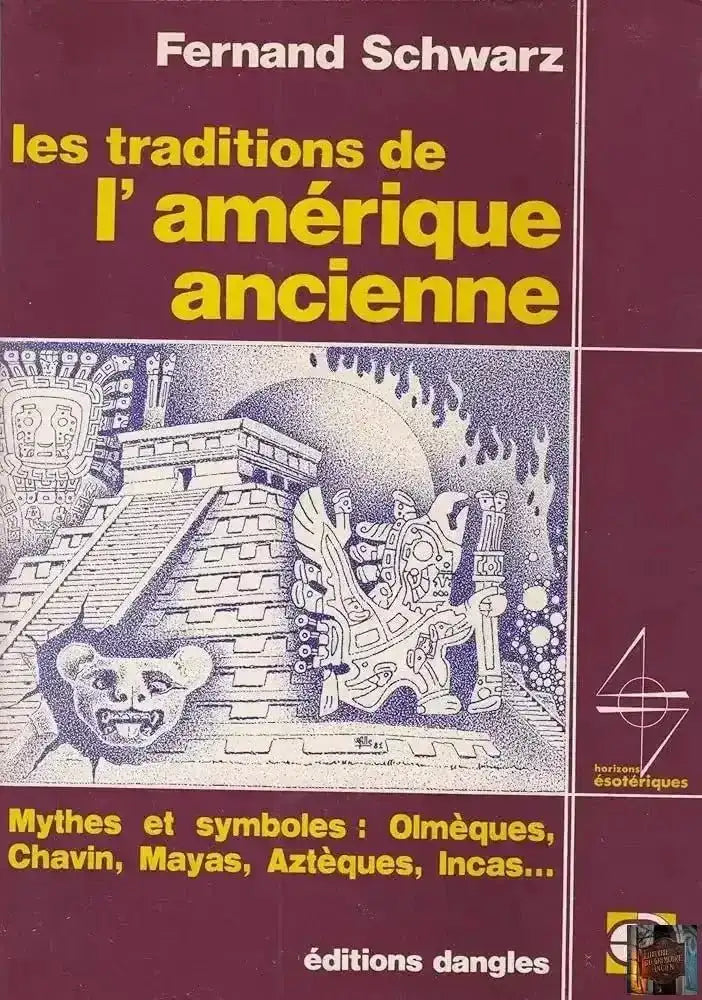
Traditions of Ancient America - Myths and Symbols
Traditions of Ancient America - Myths and Symbols
Couldn't load pickup availability
🎯 General objective of the book
The work is a comparative synthesis of the great pre-Columbian civilizations—Olmecs, Chavín, Mayans, Aztecs, Incas (and others)—over nearly three millennia.
Rather than viewing them solely as "historical" or "archaeological" peoples, the author seeks to highlight the common symbolic and spiritual principles that run through these cultures, and to restore their worldview, often distorted or reduced by post-conquest narratives.
📚 Content and approach
Panorama of Civilizations: The book covers the major cultural and religious traditions of the ancient American peoples (Olmecs, Chavín, Mayans, Aztecs, Incas, etc.), describing their particularities as well as their points of convergence.
Common Symbolic Language: One of the main focuses is the search for a shared symbolic "language" or universe—recurrent images, symbols, myths such as the jaguar, the condor, the serpent, or the connection to sun worship.
Study of Sacred Sites and Remains: The author discusses many major sites (including mythical or sacred places according to tradition)—examples: the Nazca Lines, the "Gateway of the Sun," the Temple of Quetzalcoatl, sites such as Chavín de Huantar (Peru), Paracas, Tiahuanaco (Bolivia), Teotihuacán (Mexico), Cuzco, Machu Picchu... These places reveal, according to the author, a spiritual, cosmic, cosmological dimension, reflecting the worldview of these peoples.
Visual and Iconographic Richness: The book relies on a significant number—over 200—of iconographic documents (drawings, photographs, facsimiles) to illustrate symbols, art, architecture, ritual objects... This visual work helps to "bring these lost civilizations back to life" and make their symbolic universe accessible.
Spiritual and Comparative Perspective: More than a simple history or archaeology book, this text aims to be a spiritual—philosophical or "esoteric"—exploration of Amerindian traditions, to show that these cultures had a coherent, complex, spiritual worldview—often misunderstood or distorted after colonization.
🔎 A nuanced approach: diversity + universality
One of the major interests of the work is to capture both the diversity of cultures (each civilization has its particularities: myths, rituals, architecture, calendar, forms of social organization...) and what—according to the author—falls under a kind of symbolic universal common to the peoples of ancient America.
Thus, through comparison, Schwarz seeks to do justice to these peoples—not as "primitive" but as bearers of a rich spirituality, cosmic sensibility, and powerful creative imagination.
✅ Why this book may be of interest
It provides an overview of the major pre-Columbian civilizations, which can serve as an introduction or synthesis for someone discovering the subject.
It highlights the spiritual and symbolic dimension of ancient America—an aspect often ignored in "classical" historical narratives.
Thanks to the many visual documents, it helps to visualize art, architecture, myths—which enriches understanding beyond abstract concepts.
Finally, it encourages a comparative and reflective reading: by showing convergences and diversities, it encourages us to think of ancient civilizations not as fixed objects, but as living cultural worlds, endowed with meaning and depth.
Sous réserve de disponibilité chez l'éditeur.
View full details