
The Little Prince
The Little Prince
Couldn't load pickup availability
"The Little Prince" is a poetic and philosophical tale where a pilot stranded in the desert meets a child from another asteroid, whose story deeply questions friendship, love, and the meaning of life.
In-depth Story
- The narrator, a pilot who has crashed in the Sahara Desert, meets a little boy who asks him to draw a sheep.
- Little by little, the child tells him that he comes from a tiny planet (asteroid B 612) where he lived alone with three volcanoes and a unique flower: a rose as beautiful as it was capricious, which he loves but does not understand.
- Frustrated and hurt by the rose's demands, he leaves his planet to travel from world to world and meets a series of caricatural "grown-ups": a king obsessed with authority, a vain man who lives only for applause, a drunkard trapped by his vice, a businessman obsessed with possessions, a lamplighter exhausted by routine, a geographer who knows nothing of the real world.
- Arriving on Earth, the little prince meets an enigmatic snake, then a fox who teaches him what it means to "tame": to create bonds that make the other unique in the world.
- Thanks to this friendship, he understands that he loves his rose precisely because he has taken care of her, watered her, protected her, listened to her: "one sees clearly only with the heart" becomes the central lesson of his journey.
- The ambivalent ending involves the snake, which allows him to "return" to his rose: the body remains on Earth, but the aviator understands that the essence of the little prince (his laughter, his light) remains in the stars.
Major Characters and Symbols
- The little prince: he embodies innocence, curiosity, the ability of children to ask essential questions and not give up until they have an answer.
- The aviator: he is an adult who has kept the child he once was within him, but had buried it under the constraints of life; the encounter with the little prince is an inner journey of reconciliation with his imagination and sensitivity.
- The rose: she symbolizes love, fragile beauty, jealousy, and the fear of being abandoned; behind her whims lies a true tenderness that the little prince only perceives after leaving her.
- The fox: a spiritual guide figure, he teaches that "to tame" means investing time, attention, and fidelity, which makes the other irreplaceable.
- The snake: discreet, unsettling, it represents death as a passage, the possibility of a return to the essential rather than a purely tragic end.
- The planets and their inhabitants: each embodies a deviation of the adult world (power, vanity, addiction, possession, meaningless routine, abstract knowledge), giving the book a very subtle satirical dimension.
Philosophical Themes
- Childhood versus adulthood: the novel contrasts the simple, wondrous, and profound vision of a child with the cold rationality, obsessed with numbers and conventions, of adults.
- Love and responsibility: the bond with the rose shows that love is not just emotion, but responsibility: "you become responsible forever for what you have tamed."
- Friendship: the encounter with the fox and the relationship with the aviator show that friendship requires time, patience, and rituals; it is what gives meaning to life.
- The meaning of life and solitude: in the desert, a place of stripping away, the two characters confront solitude, the fear of death, and the question of what remains when everything else disappears.
- The invisible and the essential: the work emphasizes what cannot be seen with the eyes (feelings, bonds, fidelity, memory) but truly structures a human existence.
Style and Reading Experience
- The text adopts the form of a very simple children's story, with short chapters and an almost oral tone, yet each scene has a strong symbolic meaning.
- Saint-Exupéry's own illustrations (closed boa, open boa, the little prince on his planet, the rose under its globe...) reinforce the naive and poetic dimension while serving as symbolic markers.
- The reading is quick, but the book can be re-read at different ages: as a child, it's a tale of adventure and friendship; as an adult, it's a meditation on the loss of wonder, regret, and the need to find one's "inner child."
Sous réserve de disponibilité chez l'éditeur.
View full details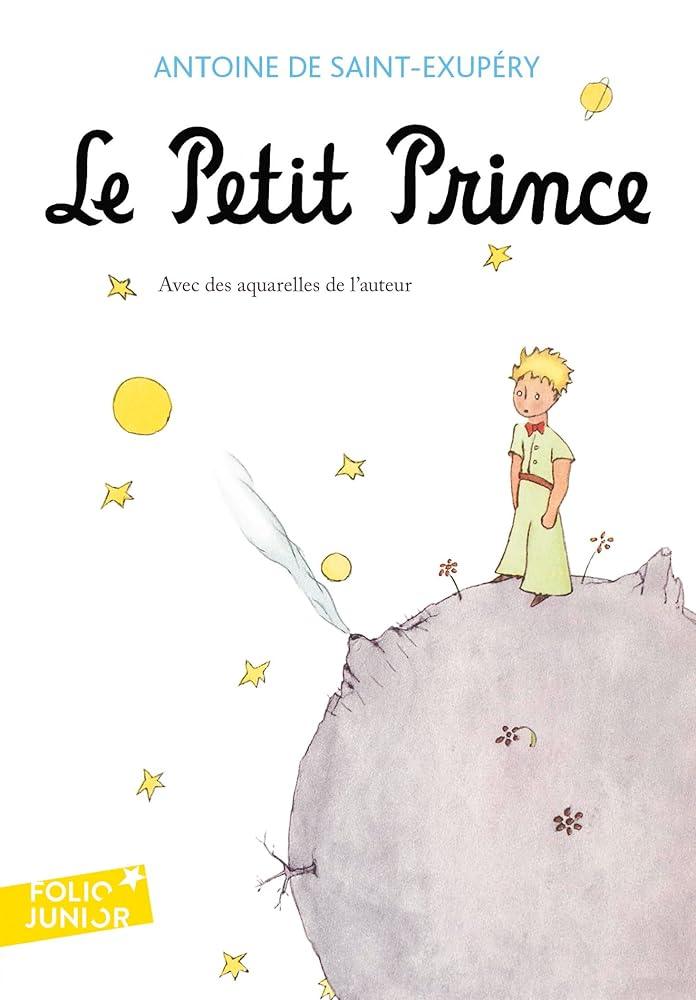
- Format très agréable et belles illustrations : un must
- Joli livre acheté comme cadeau pour un petit garçon. Un livre à lire au moins une fois dans sa vie
- Le livre correspond à la description, livraison rapide
- 5 stars: 14 (82%)
- 4 stars: 3 (18%)
- 3 stars: 0 (0%)
- 2 stars: 0 (0%)
- 1 star: 0 (0%)
Beau livre acheté pour faire un cadeau à un petit garçon. Livre à avoir lu au moins une fois dans sa vie à tout âge.
Livre offert à une étudiante en français langue étrangère
Parfait
Format très agréable et belles illustrations : un must
Incontournable
Parfait
Je l’ai acheté pour ma petite sœur pour un travail scolaire. Il est très bien !!!
Très bon livre
c'est un livre d'une histoire bien connue
Pour les enfants, le classique d’Antoine de Saint Exupéry.
livre conforme à la description envoi rapide
Top
Ceci est parfait
achats pour le college recu dans les t emps
Parfait, egal a celui que j'ai étudié au collège il y a 48 ans
Mon livre de chevet par excellence, dont mon premier exemplaire m’a été offert par ma mère, merci maman. Racheté, plus tard, dans un coffret (CD|DVD) 70e anniversaire contenant l’enregistrement original de 1954 par Gérard Philipe sur une sélection d’extraits. Concernant l’esthétique de l’édition, rien a dire que des compliments un livre souple mais illustré dans un joli coffret épuré et protecteur. Concernant le contenu, une histoire douce d’une moral tranchante sur l’importance accordée, par les grandes personnes, aux choses trop dérisoires de la vie. Un classique intemporel, inspirant et indispensable. Un conte qui m’a bercée pendant bien des années, à mettre entre toutes les mains et à tout les âges de la vie, dans toutes les bibliothèques, qui nous donne envie d’apprendre à dessiner des moutons, à cultiver nos roses et à apprivoiser des renards. Le Petit Prince est la merveilleuse histoire d’innocence d’un enfant qui ne répond pas aux questions mais n’abandonne jamais les siennes et dont on tire de nouvelles reflexions philosophiques à chaque relecture.
« Il était une fois un petit prince qui habitait une planète à peine plus grande que lui, et qui avait besoin d'un ami... »Ah ! Ce cher petit prince ! Il ne répond jamais à nos questions ! 😅La première fois que j'ai lu ce livre, c'était en 6ème et je l'ai trouvé enfantin ; je n'ai pas apprécié. 🙅🏾♀️La seconde fois, c'était il y a deux ans et j'ai eu un total coup de foudre ! 💘C'est donc la troisième fois que je lis ce livre 😝« Les grandes personnes ne comprennent jamais rien toutes seules, et c'est fatiguant, pour les enfants, de toujours et toujours leur donner des explications... »Un livre plein de douceur et qui nous fait entrer dans le monde d'un enfant. On perçoit le monde à travers ses yeux et on prend conscience que certaines choses sont dérisoires : les biens matériels, le pouvoir, l'argent, et j'en passe. Au final, nous ne sommes qu'un grain de poussière dans cette immensité... ✨« Voici mon secret. Il est très simple : on ne voit bien qu'avec le cœur. L'essentiel est invisible pour les yeux. »Bref, un classique court et inspirant. Je ne peux que vous le conseiller. Et de dessiner un mouton 🐑 et d'apprivoiser un renard 🦊« Mais les yeux sont aveugles. Il faut chercher avec le coeur. »
