
From Hell
From Hell
Impossible de charger la disponibilité du service de retrait
Pour faire face à un chantage concernant la naissance d'un enfant né de l'union inavouable d'un petit-fils de la famille royale et d'une prostituée, la Reine Victoria dépèche son médecin, William Gull, afin de régler ce problème.
Celui-ci, tout en suivant les ordres de la Reine, va néanmoins poursuivre ses propres plans. Les meurtres atroces qu'il va commettre à Whitechapel durant l'automne 1888 défrayeront la chronique?
Le mystérieux assassin, surnommé Jack l'éventreur, ne sera jamais identifié par la police.
Les crimes qu'il commet auront pour Gull/Jack l'éventreur une portée telle qu'ils provoqueront chez lui des visions terrifiantes d'un XXe siècle froid et inhumain ?
Sous réserve de disponibilité chez l'éditeur.
Afficher tous les détails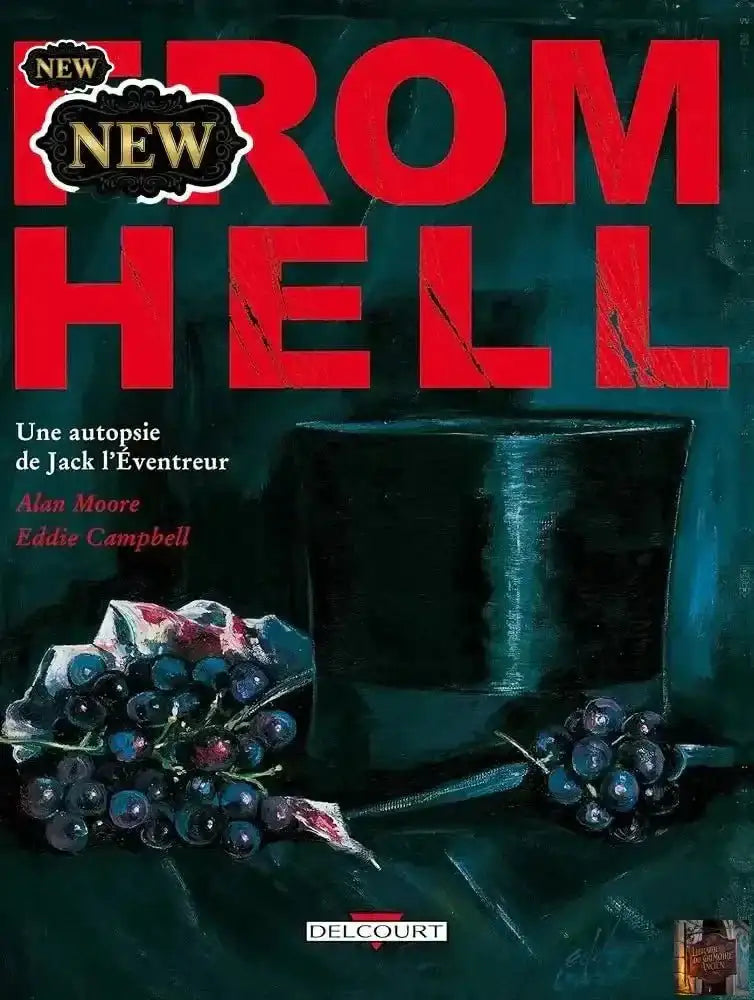
- 5 stars: 13 (65%)
- 4 stars: 4 (20%)
- 3 stars: 2 (10%)
- 2 stars: 1 (5%)
- 1 star: 0 (0%)
In preparation for the opening of the film version of "From Hell" I have been rereading Alan Moore and Eddie Campell's sixteen-part melodrama/graphic novel. It is pretty clear to me from the trailers and commercials I have seen for the film that the Hughes brothers have played around as much with this story as Moore and Campbell have played around with the "facts" of the Jack the Ripper story. But since we will never know the "truth" about Jack--scholars cannot even agree on exactly who he killed, which you would think was a rather important starting point in constructing any sort of theory--all that really matters is whether "From Hell" tells a compelling story. By that standard, "From Hell" certainly succeeds.In the Appendix to each chapter Moore careful details his sources, alterations and inventions for "From Hell" on a page-by-page basis. While such elaborations will only serve to infuriate most scholars of the Ripper, they are certainly of interest to us poor neophytes who cannot help but be fascinated by the details of the unsolvable mystery. Moore is working primarily off of Stephen Knight's "Jack the Riper: The Final Solution," which advances what Casebook: Jack the Ripper (the world's largest on-line public repository of Ripper-related information) labels the most controversial Ripper theory. Known as the Royal Conspiracy theory, it does have the delicious quality of involving virtually every person who has ever been a Ripper suspect. Despite its popularity, Ripperologists pretty much universally dismiss the theory (it ranks 8th on their list, mainly because one-third rated it 10 and another one-third rated it 1). But then the most popular suspect is currently James Maybrick, brought into prominence by the "Diary of Jack the Ripper" hoax (ah, but was it really?). Given everything that is out there, it is no wonder that the most "legitimate" suspect of the day, Francis Tumblety, gets lost. But all of this just reinforces the idea that "From Hell" is not history, but rather drama. Time and time again, it is the rationale of the STORY rather than the FACTS that drive Moore's narrative.The artwork by Eddie Campbell, aided and abetted at various times by April Post and Pete Mullins, is certainly evocative of the tale. I even think there is a point at which the reader has to be grateful that the bloodier episodes are rendered in stark black and white drawings. Campbell presents various styles at different times in the narrative, altering it to match the narrative. But it is Moore's epic story that captivates throughout as he puts his giant jigsaw puzzle together from all the evidence and his own speculations. When Moore works in the conception of Adolf Hitler, which happened in Austria around the time of the murders, as an ironic counterpart to his narrative, it is hard not to be impressed, just as we are horrified by the clinical details of the Ripper's murder of Mary Jane Kelly, which takes up all of Chapter 10. Through deduction, induction and abduction, Moore creates a compelling story and the fact that it is not what really happens has little to do with how much we enjoy "From Hell."Do I believe that Sir William Gull was indeed Jack the Ripper? No, I do not. I have heard many theories regarding his true identity that have been plausible, at least at face value, and I am more than willing to lead it to the knowledgeable experts to argue out their respective merits. But I was not reading "From Hell" to be convinced of the guilty or innocence of any one regarding the world's first infamous serial killer. I read it because as we have known ever since Alan Moore did his own take on the Swamp Thing, one of his greatest strengths as a writer is to make us look at old things in new ways. Now, if only the movie version can be half this good.
Excellent book. Great dialogues with loads of historical references of various sorts. The art is masterful, the strips engaging, well in tune with the subject(s) it deals with.
Grand fan de Alan Moore, je voulais découvrir cette oeuvre, et en langue originale cela va de soi. Quelle ne fut pas ma surprise quand je découvrit les pages en français. Cela n'enlève rien au charme de l'oeuvre, mais il faudra préciser que c'est bien en français et non en anglais qu'est édité ce livre.
Envoi rapide. Les dessins sont superbes. L'histoire intéressante. Le livre est assez grand et surtout épais.
Un comics de haute qualité culte que je conseille a tout le monde voulant avoir de la culture sur les comics américains
Comme beaucoup j'ai d'abord vue le film avant de lire le livre... Le livre apporte une autre vision car il commence du point de vue du tueur lui même et pousse a connaitre beaucoup plus Sir William Gull et son état d'esprit que dans le film , une petite déception cependant pour le personnage de l'inspecteur Abberline ( Joué par Johnny Depp dans le film ) qui est plutôt quelconque et sans charisme ici... Toujours sur fond d'une Londre Victorienne et de complot Royale et Franc-maçonnique , J'ai été a nouveaux sur le cul de voir a qu'elle point Alan Moor pousse ses création a la précision et a la perfection , en effet que ce soit dans cette oeuvre ou dans les autres , il ne laisse jamais rien au hasard , a chaque fois que l'on referme un de ses livres , il nous pousse a la réflexion voir même a la méditation sur notre condition d'humain , sur notre société moderne. Alan Moor est sans aucun doute un Dieu du Comics conscient , sombre et mature.
Retrouvez cet article en intégralité et en images sur le blog Bruce Lit ( brucetringale.com), le rendez vous des amoureux des Comics Mangas Bd.En 1888 à Londres, un descendant royal, le Prince Eddy, a un enfant avec une vendeuse de bonbons. Ses amies prostituées, avec à leur tête une certaine Mary Kelly, pensent innocemment se faire quelques sous en faisant chanter la Couronne. En leur envoyant son médecin, William Gull, nettoyer l’affaire, la reine Victoria est loin de se douter qu’ elle a ouvert les portes de l’Enfer !Gull est un chirurgien de renommée . C’est aussi un Franc Maçon versé dans les sciences occultes persuadé que les lignes temporelles de notre humanité sont bâties comme une arche, que les coïncidences n’existent pas et que Londres, construite dans le sang, exige des sacrifices humains.En dessinant dans le sang de ses victimes un pentagramme à travers Londres, Gull est convaincu d’être investi d’une mission qui maintiendrait en respect les forces du Chaos. En tuant les prostituées les unes après les autres, il pense en effet freiner l’ascendance féminine sur les sphères hiérarchiques britanniques, préserver la Couronne du Chaos, et éviter a tout prix les décollations royales. Rien de personnel donc, Gull se voyant d’avantage comme l’outil du Destin.De meurtre en meurtre, il devient le tueur en série le plus célèbre de l’humanité. Jamais pris, son identité restera un mystère au fil des siècles et Moore brosse sa vérité historique au fil d’un processus intellectuel passionnant reposant sur des archives, des témoignages, des séquences imaginaires plausibles et des concomitances mystiques. C’est ainsi qu’il établit une correspondance audacieuse entre le premier meurtre de Gull et la date de conception d’Adolf Hitler !Une séquence montre en effet s’accoupler papa et maman Hitler tandis que Jack prémédite son meurtre. Puisque durant tout l’ouvrage il est établi que l’histoire se répète à intervalle régulier, quoi de plus naturel que les actes du plus célèbre tueur en série donnent naissance au plus célèbre criminel contre l’humanité ? Que l’ homme qui assassinait le sexe faible engendra celui qui haïssait les faibles ?Pourtant, à la différence de la Moustache Furieuse, William Gull a, de l’aveu même de Moore, un versant sympathique qui, à défaut d’empathie, inspire tout du moins le respect. On peut comprendre ce qui attira Alan Moore chez ce personnage : Gull est un monument de culture tout aussi capable de disserter de poésie que de chirurgie, d’architecture ou de franc maçonnerie.Moore effectue un tour de force à se glisser dans la peau de l’assassin sans que celui ci n’ait l’air d’un illuminé notoire. Les liens qu’il fait entre magie, histoire et sciences occultes sont suffisamment érudits pour que Gull soit pris au sérieux. Pour autant que ses meurtres apparaissent barbares, Gull les accomplit sans cruauté ni sadisme : il ne viole, ni ne torture ses victimes.Malgré cela, on est gré à Alan Moore de ne pas installer son lecteur dans un syndrome de Stockholm qui nous ferait apprécier la présence de l’éventreur. Gull reste un être hautain, froid et méprisant des classes inférieures, capable d’éventrer une prostituée sans remord pour ensuite se coucher paisiblement et embrasser madame. Moore effectue d’ailleurs des pieds de nez amusants à son lecteur : l’ignorance de son cocher que Gull déplore fait écho à celle du lecteur lambda obligé de se référer aux annexes du bouquin pour saisir la portée des références.A la fin de ouvrage, Gull est pris de visions et voit le siècle venir, notamment la froideur et la perfection de l’ère informatique. Il déclare alors avoir accouché du siècle qui viendra. C’est pourtant immédiatement au nazisme que l’on pense : Gull précède les expériences et les crimes des nazis au nom d’un Reich pur et du maintien des seigneurs en haut et des esclaves en bas. Ces criminels de masse, instruits pour la plupart, qui accomplissait leurs meurtres de manière rationnelles et dépassionnés ( pas tous hein ? ). Et à plusieurs reprises, Moore décrit le terreau antisémite de l’époque visant, faute de preuves, à imaginer un coupable forcément juif !Car, aussi brillante soit elle, From Hell, n’est pas qu’une enquête visant à mettre en lumière l’identité d’un tueur légendaire. C’est aussi et surtout la description des conditions de vie épouvantables des femmes de cette époque obligées de se prostituer pour vivre. Une scène est particulièrement éprouvante : celle où Gull dort comme un bébé le matin de son premier meurtre juxtaposée à ses futures victimes dormant sur le trottoir, côte a côte, attachées par une corde à linge pour ne pas tomber par terre. Pour un lecteur contemporain, l’image de ces femmes traitées comme des bêtes et réveillées sans ménagement comme dans un poulailler est insupportable. From Hell, c’est aussi l’histoire de la lutte désespérée d’une caste qui, pour s’accrocher au pouvoir, confond intérêt particulier et bien public. La reine Victoria est montrée c...
Superbe bande dessinée. Un univers très particulier. Quand vous abordez ce livre vous ne pouvez plus le quitter. Doit figurer dans toute bonne bibliothèque. Top 10.
tout c bien passé, transaction rapide et prix réellement interessant... mais!!! mais!!!! il est en anglais et pas moyen de l'echanger contre une version française.... mmmmh tant pis pour moi mais faites attention...
Ayant découvert Alan Moore par watchmen et l'ayant vraiment adoré, je me suis penché sur une autre de ses oeuvres.From Hell donc, comics de presque 600 pages, on a l'impression que c'est plus un roman qu'une BD au premier coup d'oeil.La couverture est belle, mais quel dommage que cela soit une couverture souple, pour l'avoir en cartonné, il faut prendre l'édition 25 ans qui beaucoup plus cher.D'ailleurs en parlant de prix, je trouve étrange que le prix conseillé soit de 49,95 et qu'Amazon le vende 47,45 vu qu'au dos du livre il y'a d'imprimé 45€.Je l'ai dégoté dans mon cas à 35€ Neuf.Passons ce détail et revenons à l'essentiel, le contenu.Le style graphique peut rebuter au 1er abord, très hachuré, assez "minimaliste" je trouve notamment au niveau des visages, une page venant de coinbd pour illustrer mes propos[...]En même temps cela colle bien à l'ambiance sombre et parfois crasseuse du récit\époque, mais passé cela, on a une histoire très travaillée et fouillée au niveau de l'écriture c'est l'essentiel je dirais. Je n'ai pas encore fini de le lire mais pour l'instant j'accroche beaucoup
Il s'agit du scénario original écrit ar A. Moore pour la BD, intéressant pour les fans inconditionnels de la BD, sinon, aucun intérêt
Si ce n’était pour Alan Moore, le prix d’Angoulême et les deux Eisner Awards, j’aurais probablement abandonné cette BD avant les 100 premières pages … Mais il me fallait voir de quoi il retournait… Bien m’en a pris, puisque mon effort a été récompensé en conséquence.Il est vrai que si on n’accroche pas d’emblée, on peut être très vite rebuté par cet impressionnant pavé. De plus, le trait n’est pas spécialement engageant, et ça, ça n’aide pas. Si le noir et blanc est plutôt adapté, le style est très graphique, imprécis et au bord de l’esquisse, et les personnages ne sont pas toujours très reconnaissables, ce qui est gênant vu leur nombre et m’a obligé à revenir plusieurs fois en arrière pour comprendre qui était qui, qui faisait quoi. Par ailleurs, l’histoire m’a paru extrêmement confuse dans les premières pages.C’est seulement lorsque j’ai commencé à assembler les pièces du puzzle que j’ai été embarqué par l’histoire. Du coup, j’ai fini par reconnaître les qualités de l’objet, y compris graphiques. A certains moments, notamment la longue scène éprouvante du crime final, celui de Marie Kelly, l’imprécision et la « saleté » du trait permet de suggérer davantage que de montrer, évitant ainsi toute complaisance dans le voyeurisme tout en renforçant paradoxalement l’horreur. L’incursion dans l’ésotérisme Franc-maçonnique confère à l’ouvrage une dimension mystique fascinante, et permet en même temps de mieux cerner la folie du personnage, qui si l’on en croit Alan Moore, cherchait par ces meurtres à atteindre un niveau de conscience supérieur. Il faut reconnaître que le projet est très ambitieux et très documenté. Et même si Sir William Gull, chirurgien de la reine, est présenté comme étant l’assassin, l’auteur fait preuve de probité en évoquant à la fin toutes les hypothèses, plus ou moins discutables, qui, depuis plus d’un siècle, ont fleuri autour du mythe d’un tueur qui n’aura jamais été identifié, une manière pour lui de rappeler qu’il ne prétend pas détenir la vérité, si plausible sa démonstration soit-elle.J’aurais pu facilement mettre la note maximum avec un scénario plus concis et plus intelligible en particulier au début. Car la puissance de l’histoire est indéniable. Le malaise, parfaitement distillé, notamment dans la fameuse scène du dernier crime, finit par vous gagner. Après avoir scruté les tréfonds du cerveau noir de l’Eventreur, qui prétendait agir « depuis l’Enfer », c’est un drôle de goût de sang qui vous vient dans la bouche...
Exactement Ce que j'ai demandé, super jue, super édition, bon prix et bon état, tres satisfait de mon achat. Cool
Une oeuvre exceptionnelle, un scénario de fou, des dessins de malheur, on y devient accro, on ne le lâche plus et puis on pleure parce que c'est déjà fini...Bref, une merveille!
la bd est chère mais fait dans les 600pages. Les textes sont de grande qualité, en même temps c'est du alan moore! Les images sont en noir et blanc. Le scénario est très élaboré, l'histoire est passionnante. Le film éponyme avec Johnny depp est tiré de cette bd. Bref c'est un classique à lire et à relire
C'est exceptionnel.Malgré des passages vraiment trop bourratifs tellement ça transpire d'injection d'analyse et de connaissance (le dur chapitre de la traversée de Londres en calèche en mode guide du Routard franc maçon..), un début un peu labyrinthique et un noir et blanc charbonneux qui pourrait rebuter, le pavé de 450 pages s'engloutit. Une oeuvre phare, passionnante, monumentale dans tous les sens du terme et qui est pour moi la meilleure des lectures de Mr Moore.
"From Hell" doit son titre à la signature d'une lettre considérée comme ayant été écrite par Jack l'Eventreur. En s'attaquant à cette énigme, Alan Moore a pris un risque, tout ou presque ayant été écrit, montré sur le sujet. Et pourtant, la magie opère. Très bien documenté, l'auteur nous emmène dans le Londres de la fin du XIXe siècle et développe sa thèse avec un brio bluffant en posant une à une les différentes pièces du puzzle. C'est un peu déroutant au début, mais très vite, la magie opère, et on lit avec délectation les 500 pages de ce pavé majeur. Une bande dessinée d'exception.
L'expression "roman graphique" est parfois usurpée, mais pas ici. Un scénario fouillé. Une érudition plaisante. Une construction impressionnante. Du Alan Moore au mieux de sa forme. L'annexe est indispensable pour comprendre la richesse de la BD (qui mérite bien deux lectures). Cette annexe peut se lire parallèlement, sans crainte de gâcher l'intrigue (c'est même assez souhaitable). Reste le dessin, qui fait beaucoup parler de lui. Très sombre, crayonné rapide, il convient finalement bien à l'histoire. Par contre, et c'est le gros défaut, il est parfois si grossier que l'on peine à identifier les personnages. Il faut alors le secours du texte; mais les scènes étant courtes et le scénario fouillé, l'action est parfois terminée quand on comprend qui y a pris part !Une BD incontournable, qui passe pas loin du chef d'oeuvre, gâchée par un dessin parfois trop sommaire.
Voilà, une oeuvre comme il n'y en a que trés rarement...Jamais, nous avons était si proche du roman, mais en restant toujours dans la "BD" (suis je clair??)L'oeuvre est immense, un bon pavé, A. Moore, à réussit a s'imprégner de ce Londres macabre du siécle dernier.Les références sont là, les recherches de l'auteur sont minusieuses et trés précises (trop, peut être, à un moment donné, ou Gull (le docteur) traverse Londres, tout en la décrivant)Moore, est encore une fois irréprochable, les personnages sont tous trés "justes", on a pitié pour eux, parfois on est content pour eux et souvent on est glacé d'effrois devant la sauvagerie de l'époque;Le dessins quant a lui, peut rebuter pas mal de lecteur, mais il ne faut surtout pas s'arrêter à ça, le dessin sert l'histoire, à la fois sombre, difforme, glauque.Le seul reproche que je pourrais faire au dessin, c'est que certain personnages sont difficiles a distinguer...mais rien d'insurmontable.Bref, un Oeuvre magnifique, noire, oppressante et dérangeante, mais peut être l'oeuvre la plus précise, sur l'être qui a fait passer le monde dans le XXIéme siécle: Jack the ripper.
Moore est un génie dingue, la preuve. Déjà resonsable des sensationnels V pour Vendetta et Watchmen (entre autres chefs d'oeuvres), cette version de Jack l'Eventreur peut faire référence en la matèire, tant le sujet est incroyablement fouillé et renseigné.Chacun approuvera ou non cette version, qui parait quand même très vraisemblable...En tout cas, ces cases blanches encrées de noir simpliste convient parfaitement au sujet traité.Attention l'ouvrage est un pavé (+ de 500 pages !), il vous faudra du temps...CHEF D'OEUVRE
